
Please correct the following errors:
The Dunham School
LOCAL SCHOOL COMBINES FOCUS ON CHARACTER AND TECHNOLOGY TO BECOME NATIONAL MODEL
Special Advertising Feature
REQUEST MORE INFORMATION
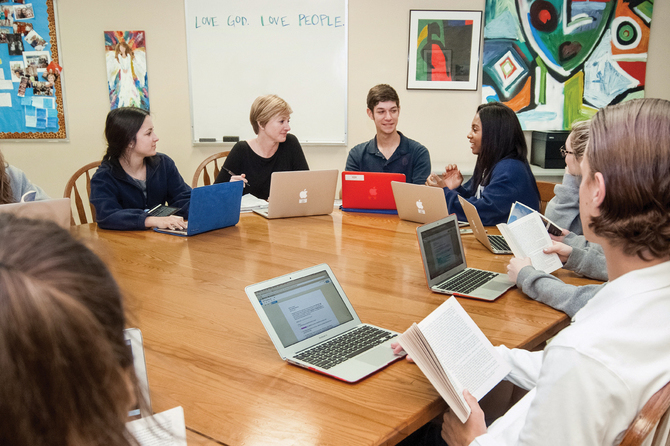
FOURTEEN STUDENTS SIT around a conference table pondering this week’s history lesson. Their instructor guides the conversation, tossing out new ideas and inviting the young men and women to chime in. The students use their laptops to access a primary source from an online library, adding another angle to the discussion. One student offers an opinion, and a classmate counters with an opposing view. A healthy discussion ensues with more students sharing their interpretations of the material. The instructor pushes them further, encouraging each one to think and defend like researchers, leaders and scholars-in-the-making.
This method of instruction, called Harkness Teaching, was pioneered in 1930 at Phillips Exeter Academy in New Hampshire, and is a well-regarded pedagogy for encouraging critical thinking. It is one of several defining features of The Dunham School, a private, independent Christian institution founded in Baton Rouge in 1981. But while Dunham enjoys healthy public awareness and claims 34 years of graduates, Capital City residents without a personal affiliation might be unaware of its substantial recent advancement and its growing national reputation, says Head of School Steve Eagleton.
“I would put The Dunham School up against any independent school in the country,” Eagleton says. “What we’re doing here is truly remarkable.”
Eagleton says Dunham’s intention is to foster creativity, thought and investigation through a curriculum that fuses classical liberal arts education with the best of modern technology. And undergirding rigorous academics, says Eagleton, is a commitment to biblical awareness and Christian principles.
“We are what I would call an authentically Christian school,” Eagleton says. “Awareness about Christian formation is not siloed to one class. Conversations about character, values and being excellent in all things are woven through the fabric of the school and the everyday experiences of our students and their families.”
Founded originally as The Chapel School and then known as Chapel Trafton until 1996, Dunham offers pre-kindergarten through 12th grade instruction. It is located on 23 acres at the back of Wimbledon subdivision off Perkins Road between Bluebonnet Boulevard and Siegen Lane. Over the last decade, the school invested $31 million in a major physical improvement project that added five new state-of-the-art buildings, including a contemporary lower school, a chapel/arts center, an academic center to support nontraditional learners, a new gym and more.
Eagleton says the campus expansion has allowed academic and enrichment programs to grow substantially.
“We have a thriving arts program and an excellent arts faculty. Our chapel/arts center has been host to community events including recent gubernatorial debates,” says Eagleton. “We have a new gym to support athletics, and our technology program is second to none.”
In 2009, the Dunham School instituted a one-to-one technology program that gives every student from first through 12th grade access to a laptop, a tool used across the curriculum, says Director of Technology Nikole Blanchard. Beginning in fifth grade (middle school at Dunham), laptops go home with students.
Since 2011, Dunham has been recognized as an Apple Distinguished School, and is the only PK-12 institution in Louisiana to earn that honor for five consecutive years. Apple’s continuous acknowledgement of Dunham, says Blanchard, is an indicator of the school’s innovation in its use of technology as well as the ability of faculty to provide solid technology instruction.
Moreover, Blanchard was recently named an Apple Distinguished Educator—one of 122 named in 2015 across the United States—a distinction that gives her access to high-level training and a global network of fellow ADEs. Dunham also has seven Google-certified teachers, with seven more currently undergoing the certification process.
“We think of our classrooms as having no walls,” says Blanchard. “We have global resources at our fingertips, and we’re using them to enhance our traditional liberal arts curriculum.”
For example, says Blanchard, in lieu of old-fashioned pen pals, Dunham’s elementary students are connecting with international classrooms via Skype and email, with each grade level assigned a different country. Kindergarten students are getting to know students their age in China by exchanging pictures of typical lunches and daily activities. Meanwhile, fourth graders are creating digital posters to share with new friends in Japan.
“We’re also doing a mystery Skyping activity where students connect with a classroom somewhere around the world, and have to figure out where that is by asking diagnostic questions and using other materials, like traditional atlases,” says Blanchard.
Technology doesn’t stop there. Dunham’s lower and middle schools both feature innovation labs, where STEM-focused activities, including coding and robotics, take place. In the upper school, students continue to learn these disciplines.
“We’ve been very focused on expanding our technology program for the last seven years,” says Blanchard. “It’s not an add-on, or offered as one class. It’s seamlessly integrated into curriculum.”
Dunham also offers an extensive athletic program, which gives young athletes the chance to compete in a variety of sports such as football, baseball, basketball, golf, cross country, soccer, swimming, softball, volleyball and wrestling. The football team earned a state championship in 2004. Eagleton says Dunham’s athletic programs are focused on success while also creating athletes with character.
“Sports are a great way to grow the integrity of our young people,” says Eagleton. “They learn about discipline, success and failure.”
Eagleton says the commitment to cutting-edge pedagogy and small class sizes (the average class size is 14-16 students) is helping Dunham propel more young men and women to top tier universities around the country and to secure merit scholarships along the way. The class of 2015 included 16 AP scholars. The top 20% in that class earned an average score of 31.3 on the ACT, while the average score for those in the college prep program was 26.4. And 82% of graduates that year received a total of $4.1 million in merit scholarships, according to school statistics. In the middle school, 73% of the class of 2020 qualified for the Duke University Talent Identification Program (Duke TIP).
Eagleton says the student population is highly engaged both in service and in enrichment activities. Sixty-seven percent of the 2014-2015 student body participated in fine arts productions. And by the time they graduated from Dunham in 2015, the senior class had accumulated 8,067 hours in community service.
Dunham’s success has brought inquiries from other independent schools around the country, says Eagleton. Recently, 40 schools looked at Dunham as a model for growing their own technology programs.
“We are likely better known throughout national circles than we are in Baton Rouge,” says Eagleton. “We’re very well-poised to continue to grow and produce graduates who are prepared for success and who can make the world a better place.”
AT A GLANCE:
WEBSITE: dunhamschool.org
EMAIL: Steve.Eagleton@dunhamschool.org
PHONE: 225.767.7097
TWITTER: @dunhamschoolbr
FACEBOOK: The Dunham School - Baton Rouge, LA